Financial Analyst AI Guide

How to Use AI as a Financial Analyst

Spend your time on insights, not copying numbers between spreadsheets.

7 chapters, 50+ pages Tools, prompts, and a 30-day plan
$39USD, one-time
Get the Guide Instant PDF download

What you get

17 prompts for variance commentary, board decks, Excel formulas, and earnings summaries
13 tools reviewed across budget levels, from free Python notebooks to enterprise platforms
Guidance on using AI as a model-checking layer to catch spreadsheet errors before the board does
01 Why AI Matters for Financial Analysts
02 Your Daily Tasks — What AI Can Handle
03 Tools You Should Know
04 Prompts That Work
05 The Dos and Don'ts
06 Your 30-Day AI Action Plan
07 What's Next

Built for financial analysts. Not "everyone."

The tools reviewed are ones financial analysts actually use. The prompts are for tasks you do every day. The action plan fits your workflow, not a generic 9-to-5. This was researched for your role from the ground up.

Sound familiar?

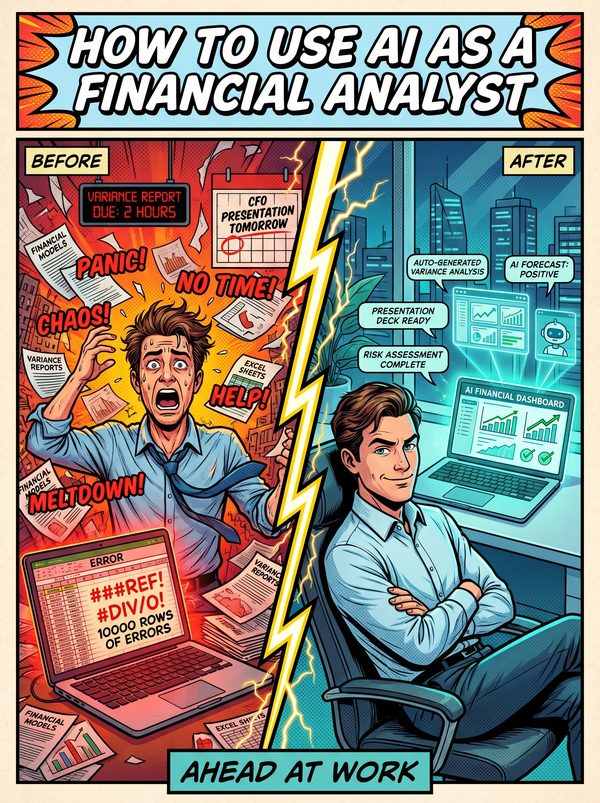
The average FP&A analyst spends 80% of their time on data gathering, formatting, and routine reporting — leaving only 20% for the strategic analysis that leadership actually needs and that would advance your career
Spreadsheet drudgery is the defining reality of the job — 94% of business spreadsheets contain errors, and hours are lost every week copying, pasting, reconciling, and manually checking formulas across workbooks
Last-minute ad-hoc analysis requests from leadership that derail your planned work — the 'can you just pull the numbers' culture where every executive thinks their request takes five minutes when it actually takes two hours of data wrangling
Reporting fatigue — producing the same monthly reports in the same format month after month, manually updating numbers that should refresh automatically, writing the same variance commentary with slightly different figures

Statistics sourced from published industry research.

80%
Being perceived as a 'data monkey' rather than a strategic thinker — you were hired for your analytical skills and financial judgment, but 80% of your day is spent on data plumbing that a well-designed system should handle automatically.

What the guide helps you do

These are real tasks from your day. The guide gives you the tools, prompts, and workflows to hand them to AI.

First-draft variance commentary and narrative explanations for budget vs. actual deviations
Summarising earnings call transcripts, 10-K filings, and analyst reports into structured briefs
Generating Excel formulas, VBA macros, and Python scripts for financial calculations
Drafting board deck narratives, executive summaries, and stakeholder update emails from raw financial data
Building scenario and sensitivity analysis frameworks with assumption documentation
Data collection and consolidation from multiple sources into standardised formats
Get the Guide — $39

You were hired for your analytical judgment. Instead, you spend 80% of your time gathering data, formatting reports, and writing the same variance commentary with slightly different figures every month. The 'can you just pull the numbers' requests hit your inbox three times before lunch, each one supposedly taking five minutes but actually requiring two hours of data wrangling.

This guide targets that exact problem. It covers 13 AI tools, from Microsoft Copilot for Excel and Power BI to AlphaSense, FinChat, and Gamma, with real pricing and honest assessments of what each tool does well at different budget levels. Some are enterprise-grade tools your firm likely already pays for. Others cost $20/month and will change how you work tomorrow.

The 17 prompts focus on the repetitive analytical tasks: variance analysis commentary, earnings call summaries, Excel formula and VBA generation, board deck narratives, scenario analysis frameworks, competitor benchmarking tables, and stakeholder update emails. Each prompt is structured for finance audiences who expect precision.

94% of business spreadsheets contain errors. The guide also covers how AI can serve as a logic-checking layer on your models, not replacing your judgment, but catching the formula mistakes that keep you up at night before board presentations.

Built for corporate finance analysts, FP&A professionals, and junior investment analysts who want to move from data plumbing to strategic analysis.

Questions

A 50+ page PDF with 7 chapters: why AI matters for your role, which tasks to automate first, honest tool reviews, 17 ready-to-use prompts, a dos and don'ts chapter so you skip the mistakes, and a 30-day action plan to actually follow through. Instant download, keep it forever.
No. The prompts work with free tools like ChatGPT and Claude. The guide covers paid options too, but you don't need them to start.
Yes. The research, prompts, and tools were chosen specifically for this role. If your day involves the tasks listed above, this was made for you.
We won't promise that. Nobody can. What we can tell you is that people who learn to use AI tools are more productive, more valuable, and harder to replace. The people at risk are the ones who pretend AI isn't happening.

Your job is changing. Get ahead of it.

7 chapters. Honest tool reviews. 17 prompts. A 30-day plan. One PDF.

Get the Guide — $39

Instant download. Keep forever.

Related guides

$39 Get the Guide