Data Analyst AI Guide

How to Use AI as a Data Analyst

Move from SQL vending machine to the person who actually drives decisions.

7 chapters, 50+ pages Tools, prompts, and a 30-day plan
$29USD, one-time
Get the Guide Instant PDF download

What you get

17 prompts for SQL generation, data cleaning, visualization code, and executive summaries
13 tools reviewed across the full analyst stack, from free notebooks to enterprise platforms
A skills roadmap bridging the $82K to $131K gap between traditional and AI-skilled analysts
01 Why AI Matters for Data Analysts
02 Your Daily Tasks — What AI Can Handle
03 Tools You Should Know
04 Prompts That Work
05 The Dos and Don'ts
06 Your 30-Day AI Action Plan
07 What's Next

Built for data analysts. Not "everyone."

The tools reviewed are ones data analysts actually use. The prompts are for tasks you do every day. The action plan fits your workflow, not a generic 9-to-5. This was researched for your role from the ground up.

Sound familiar?

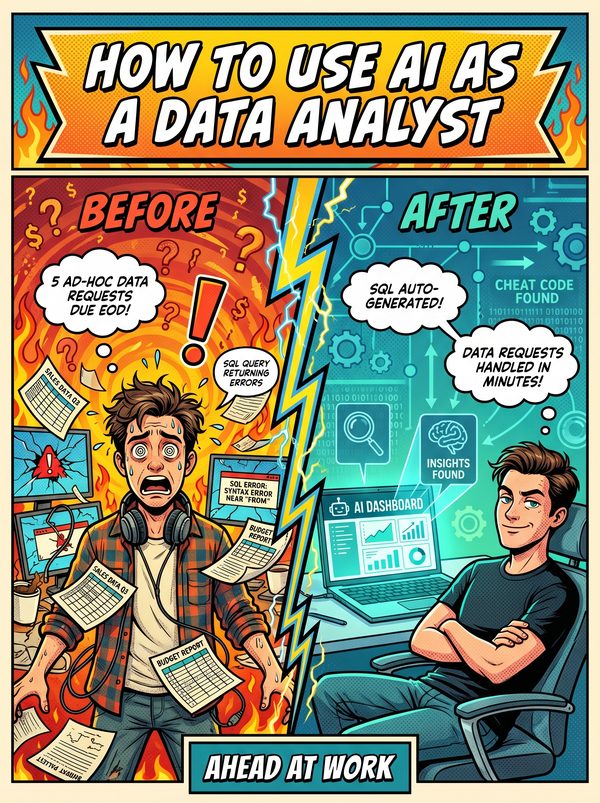
The 'just pull the numbers' culture — stakeholders treat data analysts as SQL vending machines, firing off ad-hoc requests with same-day deadlines and zero context about the actual business question they're trying to answer
The 'SQL monkey' perception — analysts get pigeonholed as query writers rather than strategic thinkers, doing repetitive data pulls instead of the insight work that actually drives business decisions and career advancement
Ad-hoc request overload — without proper systems, requests pile up, get lost, duplicated, or severely delayed, and analysts spend more time triaging than analyzing. Adding more analysts doesn't fix it, just like adding lanes to a freeway doesn't reduce traffic
Data quality nightmares — missing values, inconsistent formats, undocumented schema changes, and broken pipelines transform workdays into firefighting sessions. Data cleaning consumes up to 60% of an analyst's workday

Statistics sourced from published industry research.

80%
The 80/20 data preparation trap — analysts spend roughly 80% of their time finding, cleaning, and organizing data, leaving only 20% for the actual analysis and insight generation that stakeholders and managers value.

What the guide helps you do

These are real tasks from your day. The guide gives you the tools, prompts, and workflows to hand them to AI.

SQL query generation from natural language business questions
Data cleaning and transformation script generation (Python/pandas)
Exploratory data analysis — summary statistics, distributions, correlations, outlier detection
Chart and visualization code generation (matplotlib, seaborn, Plotly)
Executive summary and report narrative writing from raw analysis findings
SQL query optimization and performance debugging
Get the Guide — $29

AI now writes production-quality SQL from plain English in seconds. It generates Python cleaning scripts, builds visualizations, and summarizes datasets faster than most junior analysts. That is not a threat if you know how to use it. It is a threat if you do not.

Right now, you spend roughly 80% of your time finding, cleaning, and organizing data. Stakeholders treat you like a SQL vending machine, firing off ad-hoc requests with same-day deadlines and zero context about the business question they are actually trying to answer. Meanwhile, the insight work that would advance your career gets pushed to 'when I have time,' which is never.

This guide helps you flip that ratio. The 17 prompts cover your daily grind: SQL query generation from business questions, data cleaning pipeline scripts, exploratory analysis workflows, chart code for matplotlib and Plotly, executive summaries from raw findings, A/B test interpretation, and data dictionary documentation.

The 13 tool reviews cover the full stack, Hex and Julius AI for no-code analysis, GitHub Copilot for in-IDE SQL and Python, Power BI and Tableau with their AI features, dbt Cloud for data pipeline management, and DataGrip for SQL-heavy workflows. Each review includes real pricing and tells you which tier you actually need.

The career stakes are real. Traditional analysts earn a median of $82K. AI-skilled analysts command $131K, a 60% gap that is growing. The 30-day plan builds your AI skills in order: code generation first, then analysis automation, then the storytelling and communication that makes you irreplaceable.

For data analysts who are done being asked to 'just pull the numbers.'

Questions

A 50+ page PDF with 7 chapters: why AI matters for your role, which tasks to automate first, honest tool reviews, 17 ready-to-use prompts, a dos and don'ts chapter so you skip the mistakes, and a 30-day action plan to actually follow through. Instant download, keep it forever.
No. The prompts work with free tools like ChatGPT and Claude. The guide covers paid options too, but you don't need them to start.
Yes. The research, prompts, and tools were chosen specifically for this role. If your day involves the tasks listed above, this was made for you.
We won't promise that. Nobody can. What we can tell you is that people who learn to use AI tools are more productive, more valuable, and harder to replace. The people at risk are the ones who pretend AI isn't happening.

Your job is changing. Get ahead of it.

7 chapters. Honest tool reviews. 17 prompts. A 30-day plan. One PDF.

Get the Guide — $29

Instant download. Keep forever.

Related guides

$29 Get the Guide